
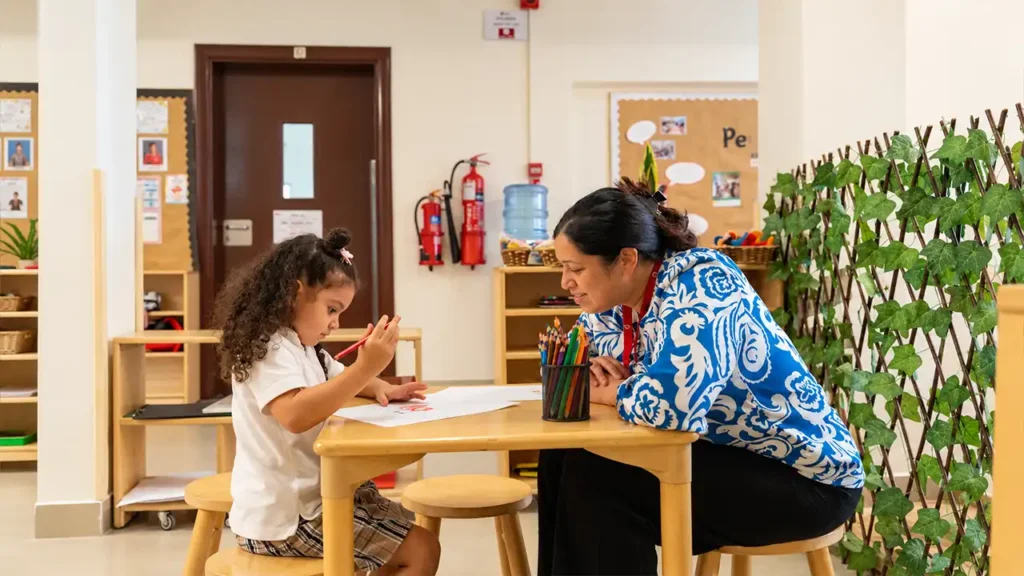
Families choosing an international school in Sharjah often assume that a British curriculum means an entirely British experience. In practice, every private school in the UAE works within a national framework that protects language, faith, and identity alongside the imported curriculum. Arabic and Islamic studies are not optional extras attached to the timetable, they are regulated components inside the school day. Understanding how these subjects are structured, assessed, and taught helps parents judge whether a school treats them as a genuine academic strand or a compliance exercise.
How Arabic and Islamic Studies Fit Into a British Curriculum School
A British curriculum school in Sharjah follows the English National Curriculum for core subjects while delivering nationally mandated subjects in parallel. There is no conflict between the two systems, but there is a design challenge: protecting enough teaching time for Arabic language education without compressing English, mathematics, or science.
Balancing local Ministry requirements with international standards is a core priority when designing the English school curriculum in Sharjah, ensuring students maintain cultural ties while receiving a global education.
Strong schools treat the mandated subjects as full academic disciplines, with the same planning rigour, tracking, and reporting applied elsewhere. Weaker schools treat them as timetable fillers, and parents usually notice the difference within a term.
What the Ministry of Education Requires
The national requirements apply to all private schools regardless of curriculum, and they are the reason Arabic and Islamic studies appear on every school timetable in the emirate.
1. Arabic for Native Speakers
Students of Arab nationality follow Arabic A, a first language programme covering grammar, literature, comprehension, and formal written expression. The expectation is fluency in Modern Standard Arabic, not conversational competence.
2. Arabic as an Additional Language
Non Arab students follow Arabic B, a second language pathway building reading, listening, and speaking progressively from the early primary years. Placement depends on nationality rather than current ability, so schools must differentiate carefully inside each class.
3. Islamic Education for Muslim Students
Muslim students study Islamic education throughout their schooling, taught in Arabic for Arab students and usually in English for non Arab Muslim students. The syllabus covers belief, worship, character, and Islamic history.
4. Moral and Social Studies
All students, whatever their faith or nationality, follow the moral education and social studies strand covering ethics, citizenship, culture, and community values. Non Muslim students take this in place of Islamic education.
Requirements are periodically updated by the authorities, so parents should confirm current arrangements directly with the school before enrolment.
Why Arabic and Islamic Studies Matter Beyond Compliance
The regulatory case is clear, but the educational case is stronger. Arabic is the language of the country a child is growing up in. A student who leaves school unable to read a contract, follow a news broadcast, or hold a professional conversation in Arabic is at a real disadvantage in a regional job market, however strong the English results are.
Islamic studies carry a cultural literacy function beyond faith instruction. Students gain the historical and ethical context that shapes the society around them, which supports the intercultural understanding international curricula claim to develop.
There is a cognitive argument too. Sustained bilingual study strengthens working memory, attention control, and the ability to switch between systems of thought. Far from diluting academic performance, serious Arabic and Islamic studies provision tends to support it.
What Effective Teaching Looks Like
Because the syllabus is largely fixed, the gap between schools in Arabic and Islamic studies appears in delivery. Effective teaching and continuous progress monitoring are embedded across every stage of the British primary programme, particularly when integrating core subjects with Arabic and Islamic studies.
1. Differentiated Grouping
Arabic B classes often contain complete beginners alongside students with several years of exposure. Effective schools group by ability within the year level rather than teaching to the middle.
2. Language Used for Real Purposes
Vocabulary retained is vocabulary used. Assemblies, displays, competitions, national day projects, and Arabic library reading turn a timetabled subject into a living language.
3. Transparent Assessment in Arabic and Islamic Studies
Parents should receive the same clarity on progress here as in English or mathematics, including attainment levels, next steps, and the support offered when a student falls behind.
How SIA Approaches Arabic and Islamic Studies
Scholars International Academy delivers the mandated subjects as a fully integrated part of the British curriculum at SIA rather than as a separate track running alongside it. Arabic and Islamic studies teachers plan within the same academic framework, share assessment cycles, and report through the same channels as every other department.
Foundations are built early. Within primary stage programme planning, Arabic begins as an oral and phonics led experience before moving into structured reading and writing, so students build confidence before they meet formal grammar. Cultural events, Arabic reading initiatives, and classroom displays extend the subject beyond the lesson, and families exploring learner life at SIA will see how language and values are reinforced across daily school routines rather than confined to one period on the timetable.
Questions Parents Should Ask Before Enrolling
A short visit reveals a great deal when the right questions are asked:
- How are Arabic B students grouped, and how often is placement reviewed?
- What qualifications and training do the Arabic and Islamic education teachers hold?
- How is progress reported, and how frequently?
- What intervention is available for a student arriving with no Arabic at all?
- How visible is Arabic across the school outside timetabled lessons?
Frequently Asked Questions
Which school in Sharjah offers British curriculum education?
Several private schools in the emirate deliver the English National Curriculum, and Scholars International Academy is among them. Rather than relying on a list, compare inspection outcomes, examination results at Key Stage 4 and 5, class sizes, and how well each school integrates Arabic and Islamic studies into its wider academic programme.
Which is better, CBSE or British curriculum?
Neither is objectively superior, since they serve different goals. CBSE is structured and content dense, closely aligned to Indian university entry and competitive examinations. The British curriculum emphasises subject specialisation from Year 10 onward, analytical writing, and coursework, feeding naturally into universities in the UK, Europe, and beyond. The better choice depends on where the family expects the child to study and how the child learns best.
Is Arabic compulsory in the British curriculum?
Not within the curriculum itself, but yes within the UAE. National regulations require all private schools to teach Arabic to every student through the compulsory years, with native and non native pathways determined by nationality. A British curriculum school in Sharjah therefore teaches Arabic alongside the English National Curriculum.
Which schools in the UAE offer the best British curriculum?
Quality varies by campus rather than by brand, so a national ranking is rarely useful. The most reliable indicators are the latest inspection rating, verified examination results, teacher retention, pastoral care, and, for families settling long term, the seriousness of the school’s Arabic and Islamic studies provision.
Conclusion
Arabic and Islamic studies deserve the same scrutiny parents apply to English results or university destinations, because these subjects shape how comfortably a child belongs to the country they are growing up in. A British curriculum school in Sharjah that invests properly in qualified teachers, differentiated grouping, and honest reporting produces students who are academically strong and culturally fluent. That combination, rather than the curriculum label alone, is what should guide the decision.