
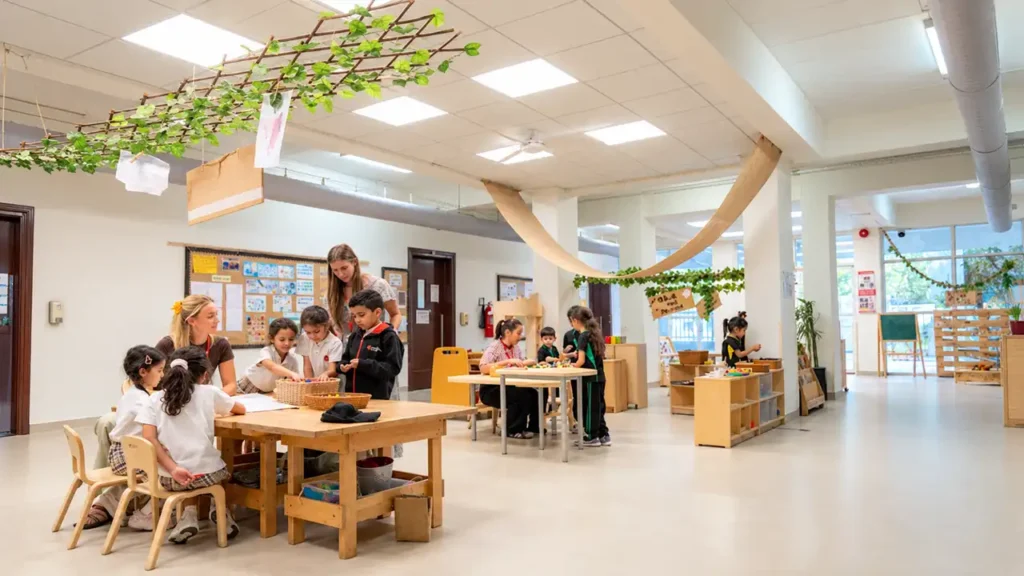
Parents comparing schools in Sharjah are asking a sharper question than a decade ago. Instead of asking which school produces the highest grades, they ask which school prepares a child for work that does not exist yet. That shift explains why STEM education has moved from an optional after school club to a central part of how strong schools design their curriculum. Understanding what it actually involves, and what separates a genuine programme from a marketing label, helps families make a far better decision.
What STEM Education Really Means
STEM stands for science, technology, engineering, and mathematics. The important word, though, is not any of the four subjects. It is the way they are connected. A school teaching these subjects in four separate silos is not delivering STEM education, it is delivering four traditional courses under a modern name.
Real STEM learning asks students to solve a problem that requires more than one discipline at once. Designing a water filtration model calls on chemistry, measurement, material testing, and cost calculation in the same task. The student is not memorising a formula for an exam, but using it because the problem cannot be solved without it.
Why STEM Education Matters in the UAE
The national direction is not subtle. Investment in artificial intelligence, space, renewable energy, advanced manufacturing, and biotechnology has created a labour market where technical fluency is a baseline expectation rather than a specialisation. Employers increasingly filter candidates on the ability to work with data, prototype quickly, and communicate technical reasoning clearly.
For families in Sharjah this matters because the emirate has built a dense research and university corridor. Students who arrive there with laboratory confidence, coding literacy, and real project experience compete on different terms than students who arrive with strong grades alone.
What Strong STEM Education Looks Like in a Sharjah Classroom
The gap between schools is rarely the equipment, it is how teaching is structured. Four markers separate a serious programme from a decorative one.
1. Inquiry Led Science
Students begin with a question rather than a conclusion. They form a hypothesis, design the test themselves, record what happened, and explain why the result differed from the prediction. Failure becomes data instead of a lost mark.
2. Applied Mathematics
Numbers are attached to a purpose. Ratio work appears inside a scale model, statistics inside a dataset the class collected, and algebra inside a design constraint. Mathematics stops feeling abstract because it is never presented alone.
3. Technology and Computational Thinking
Coding is taught as a way of thinking, not a software tutorial. Students learn to break a large problem into steps, spot patterns, remove unnecessary detail, and debug their own logic. These habits transfer to every subject, including writing and analysis.
4. Engineering Design Challenges
Students build, test, fail, and rebuild against a defined constraint such as budget, weight, or time. This cycle teaches resilience better than any assembly on the topic, because the feedback comes from the object itself rather than from a teacher.
The Benefits of STEM Education Beyond Test Scores
The academic case is well documented, but the wider benefits of STEM education are what parents notice first at home.
Students become more comfortable with uncertainty and learn to defend a position with evidence rather than volume. They collaborate under pressure because most STEM activities are too large for one person to finish alone. They also develop what universities call intellectual persistence, the willingness to stay with a difficult problem long after the first attempt fails.
There is a confidence dimension too. A student who has built something that works carries that memory into unrelated subjects. Success in these subjects tends to raise a child’s overall academic self image, which is why the effect often appears in humanities results too.
How SIA Approaches STEM Education
Scholars International Academy treats STEM as a way of teaching rather than a timetable block.
1. STEM Education Embedded in Everyday Lessons
Enquiry, challenge, and independent thinking run through daily lessons across the school, supported by the High Performance Learning approach, which is built on the principle that advanced performance is developed rather than inherited. Students are expected to question, to justify, and to transfer a method learned in one subject into another context.
2. Assessment That Rewards Iteration
Practical work is judged on reasoning and refinement, not only on whether the final result matched the expected answer. A project that failed for an understood reason is treated as evidence of learning.
3. A Framework Families Can Examine
Parents usually start with the SIA 4X Advantage, which sets out the academic, personal, and future readiness pillars behind the school’s approach. The why us? section adds a clearer picture of how curriculum, teaching quality, and student support connect.
How to Evaluate a STEM School in Sharjah
When visiting a school, the most useful questions are practical ones:
- Ask to see student work in progress, not only finished display pieces
- Ask how often students design their own investigations rather than follow instructions
- Ask how mathematics and science teachers plan together across departments
- Ask what happens when a project fails, and how that is assessed
- Ask which competitions or external projects students take part in
These five answers reveal more than any brochure or laboratory tour.
Frequently Asked Questions
Is STEM better than regular school?
In most cases it is not a separate school type but an approach applied inside a mainstream curriculum. A strong school integrates STEM education alongside languages, humanities, and the arts rather than replacing them. Children benefit most from breadth combined with depth, so the better question is how well a school connects its subjects rather than which label it uses.
What is the best special education school in Sharjah?
There is no single answer, because the right school depends on the individual learning profile. Families should look for a documented inclusion policy, qualified learning support staff, individual education plans reviewed regularly, and teachers trained to differentiate within mainstream lessons. Meeting the inclusion team and asking how progress is measured tells you far more than any ranking list.
What is the best age to start STEM?
Early years. Sorting, building, predicting, and testing come naturally to young children, so structured STEM activities can begin in kindergarten in a simple, play based form. Formal coding and engineering design usually suit ages seven to nine and above, but curiosity should never be delayed until then.
Which subject is best for STEM?
None of them individually. Mathematics is the common language across the four disciplines, so a secure foundation there supports everything else, but the value of STEM education comes from combining subjects rather than choosing one. Students should keep options open for as long as possible before specialising.
Conclusion
STEM education is not defined by robotics kits or laboratory photographs. It is defined by whether students are genuinely asked to think, test, fail, and refine. For families choosing a school in Sharjah, the clearest signal is how deeply that mindset runs through everyday lessons rather than how it appears in a prospectus. A school that gets this right produces graduates who can adapt, and adaptability never becomes outdated.