
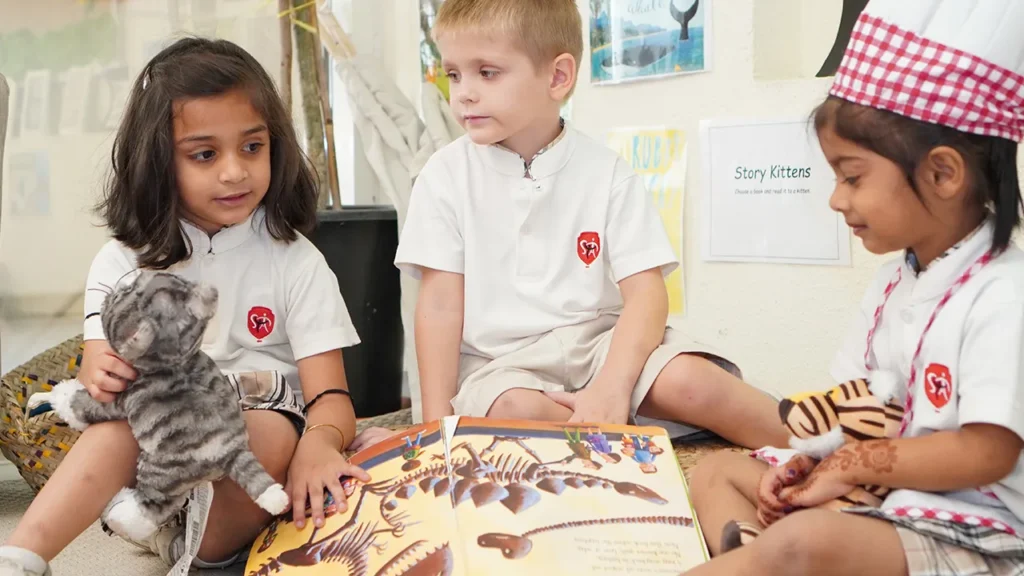
Every activity in an Early Years classroom, from a sand tray to a story circle, is planned around the seven areas of learning in EYFS. The Early Years Foundation Stage framework groups a child’s development into three prime areas and four specific areas, and teachers use them to plan, observe and support each child between the ages of three and five. This guide explains what each area covers, how the areas connect, and what parents can expect to see at home as their child moves through FS1 and FS2.
What the EYFS Framework Is
The EYFS is the statutory framework for children from birth to five within the British curriculum. It sets out the learning and development goals, the assessment points and the welfare standards that Early Years settings follow. Instead of fixed subjects, it describes areas of development, because young children learn through play, conversation and repeated hands on experience rather than through timetabled lessons.
Schools that follow the British curriculum apply the same framework across FS1 and FS2. At Scholars International Academy, the EYFS nursery at SIA (FS1 and FS2) is built on this structure, with the seven areas shaping how classrooms are set up and how each day flows.
The Three Prime Areas
The prime areas are the foundations. They develop first and fastest, and every other kind of learning depends on them.
Communication and Language
This area covers listening, attention, understanding and speaking. Children learn to follow instructions, ask questions, retell stories and take part in conversations. Story time, songs, role play and simple daily routines, such as talking about the weather or what is for snack, all build vocabulary and the confidence to use it.
Personal, Social and Emotional Development
Here children learn to manage feelings, build friendships, take turns and become more independent. Teachers model how to share, wait and solve small disagreements calmly. A settled child who feels safe in the classroom is far more willing to try new things, which is why this area is treated as the heart of the Early Years. Parents who want to see how this looks in practice can join a Stay and Play session and watch children interact in a real setting.
Physical Development
Physical development has two sides. Gross motor skills come from climbing, running, balancing and outdoor play. Fine motor skills come from threading, cutting, pouring and holding a pencil. Both matter for writing later on, since a child who cannot yet control small movements will find letter formation frustrating.
The Four Specific Areas
The specific areas build on the prime areas and introduce the knowledge and skills that lead directly into the National Curriculum in Year 1.
Literacy
Literacy in the EYFS means early reading and writing. Children begin with rhymes and sounds, move on to recognising letters and blending them into words, and then start writing simple words and captions. Many British curriculum schools, including SIA, use a structured phonics programme such as Read Write Inc from FS2 so that reading develops in a clear, predictable sequence.
Mathematics
Early mathematics is practical. Children count objects, compare sizes, sort by colour and shape, recognise numbers to 10 and then 20, and begin to understand patterns and simple addition through games. The goal is a deep understanding of number, not memorised sums.
Understanding the World
This area introduces science, geography, history and technology in an age appropriate way. Children explore nature, observe changes in weather and seasons, learn about their own families and community, and compare different ways of life. In the UAE, this often includes national celebrations, local culture and the environment around the school.
Expressive Arts and Design
Painting, music, dance, construction and imaginative play all sit here. Children experiment with colour, texture, sound and movement, and learn to share ideas through what they make. Expressive work also feeds the other areas, since a child describing a model they built is practising language and confidence at the same time.
How the Seven Areas Work Together
The areas are not taught separately. A single activity usually touches several at once. Building a bridge with blocks involves physical control, mathematical thinking about size and balance, language as children negotiate, and personal development as they cooperate. Teachers plan the environment and activities so that children meet all seven areas of learning in EYFS across the week, then observe and record what each child can do.
These observations shape the next steps for every child. At the end of FS2, the Early Years Foundation Stage Profile records whether a child has reached the expected level in each area, which gives Year 1 teachers a clear picture of where to begin. Children who leave the stage able to listen, share, hold a pencil and recognise sounds are ready for the more formal learning that follows.
What Parents Can Do at Home
Supporting the seven areas does not require worksheets. Talking about the day, reading together every evening, counting steps on the stairs, cooking, drawing and outdoor play all contribute. Giving children small responsibilities, such as putting shoes away or helping to set the table, builds independence and confidence. For families with younger children, a nursery that follows the same framework, such as SIA Nursery, makes the move into FS1 much smoother because the routines and expectations are already familiar.
FAQ
What are the seven areas of learning in EYFS?
Three prime areas: Communication and Language, Personal, Social and Emotional Development, and Physical Development. Four specific areas: Literacy, Mathematics, Understanding the World, and Expressive Arts and Design.
What is the difference between prime and specific areas?
Prime areas are the foundations of all learning and develop first. Specific areas build on them and introduce the skills and knowledge children need for Year 1.
At what age does the EYFS apply?
From birth to five. In schools this covers FS1 (ages 3 to 4) and FS2 (ages 4 to 5), after which children move to Year 1.
How is progress assessed in the EYFS?
Through ongoing teacher observation during play and activities, with the Early Years Foundation Stage Profile completed at the end of FS2.